
Search our website enhanced by Google.
Updated 25 March 2026
Reporting period: Weeks 10 to 13 (1 March to 28 March 2026)
Key points:
The recovery in the dairy market has continued despite being buffeted by the winds of global conflict. All commodities have seen average prices increase over the period. However, while SMP has seen a linear march upwards and Cheddar has seen supply and demand balance, butter and cream markets have been much more volatile.
While strong gains were made mid-month the latter part of the month have seen some of these gains lost as supply-side fundamentals begin to bite.
SMP continued to be the ‘star of the show’ with prices continuing to increase over the course of the month ending at an average of £2,340, a growth of £300/t or 15% since last month. It is the only commodity that is more valuable than a year ago.
The conflict in the Middle East has pushed prices onwards, removing the world fourth-largest SMP exporter (Iran) from the equation. Despite huge amounts of milk relatively little SMP has been made globally as milk has been directed to higher value streams such as cheese and whey or to other protein options like MPC.
Europe has become increasingly price competitive in this space and demand has grown as manufactures are increasingly looking to SMP over other more-expensive protein options. Dryer-space is the key limitation as we pass through the flush.
The mild Cheddar market showed mixed signals during the period.
Cheddar stocks are reportedly tight after much curd was sold last year to drive cashflow. Both mild and mature are said to be limited. Mature cheddar in particular is not easy to get hold of. Demand is strong but sellers don’t want to quote too far into the future.
Reports indicated that Cheddar’s position was weak against both mozzarella and gouda which is unusual.
Confidence in the market is relatively low given the potential for trade disruption going forwards.
The average price for mild Cheddar was £3,080/t, which is 5% higher than the previous period.
Prices have overall seen a large degree of recovery with prices soaring through the month, rising from £1.28/kg at the start of the month to a peak of £1.77/kg.
There were some reports of good valorisation available from turning cream into profitable AMF following good performance on the GDT. However, rapidly increasing freight rates have caused many to pull back from the market sending cream prices back down to £1.50/kg.
Reports indicate the cream price on the continent are ‘crashing.’ Fundamentally there is a huge amount of cream available globally with Europe in particular reporting a ‘super-flush.’ This is putting pressure back on cream which averaged £1,556 for the period, a welcome but uncertain rise of 24%.
The gap between cream and butter has closed significantly however cream remains undervalued compared to butter.
Overall, bulk cream averaged £1,556 per tonne for the period, an increase of 24% compared with February. Despite this rise, cream remains priced lower than butter on a relative basis.
Prices have been described as extremely volatile.
In the middle of the period butter prices were flying, going as high as £4,150. There was some growth of demand from Europe as New Zealand product was diverted to South East Asia, away from the Middle East who then looked towards European suppliers driving demand short-term.
However, reports indicate there are large amounts of butter in store and the Irish are clearing their end of financial year stocks.
European product remains at a discount to Oceania but trade in that direction has slowed as freight and logistical costs and challenges increase causing traders to take a step back from the market. This has caused prices to lose momentum and return to downturn falling to as low as £3,700-£3,800 at the end of the period in some quarters.
The average butter price was £3,980 per tonne, an increase of 8% compared with the previous period.
Table 1. UK wholesale prices (ex‑store)
Prices refer to spot trades agreed between 1 March and 28 March 2026.
| Product | March 2026 average (£/tonne) | Range(£) | February 2026 average (£/tonne) | Percentage change | March 2025 average (£/tonne) | Year‑on‑year Percentage change |
|---|---|---|---|---|---|---|
| Bulk cream | 1,556 | n.a | 1,250 | +24% | 2,624 | −41% |
| Butter | 3,980 | 635 | 3,670 | +8% | 6,070 | −34% |
| SMP | 2,340 | 260 | 2,040 | +15% | 2,010 | +16% |
| Mild Cheddar | 3,080 | 445 | 2,920 | +5% | 4,020 | -23% |
Source: AHDB
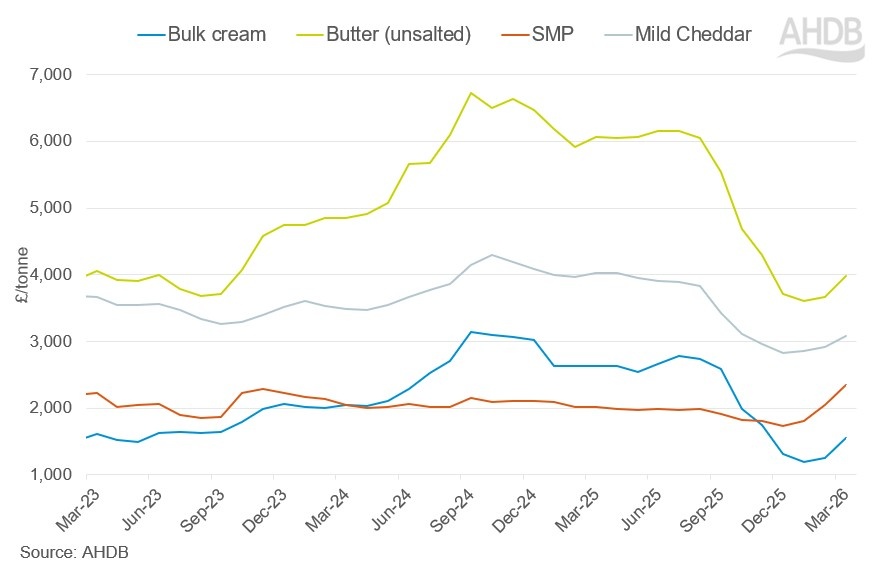
Figure 1. UK dairy product wholesale prices
Source: AHDB
Figure 1 shows average UK wholesale prices from early 2023 to March 2026, measured in pounds per tonne.
Butter prices remain consistently higher than the other products throughout the period. All four products show a steep decline from late summer 2025 into early 2026, followed by modest recovery in February and March 2026.
SMP shows the strongest improvement in early 2026 compared with the other products. Bulk cream remains the lowest‑priced product across the period.
The published prices will not necessarily match the overall actual price achieved by a milk processor as this will depend, among other things, on the proportion of product that is sold on the spot market and the proportion sold under longer term contracts and at what price this is done.
The 'average' prices should be used to track trends while the commentary will contain prices seen through the month.
Note: There has been a change in the methodology for determining the bulk cream price from January 2021.
Information on prices and market conditions is gathered through a monthly phone survey of dairy product sellers, traders and buyers.
Panel discussions cover ex-store prices on spot trades agreed within the reporting period and delivered within a maximum of 2 weeks for bulk cream and 6 weeks for butter, SMP or cheese.
For butter, skimmed milk powder (SMP) and mild Cheddar, prices are indicative of values achieved for spot trades and exclude contracted prices or forward sales.
For bulk cream, a weighted average price will now be reported. This is based on submissions of an average price for agreed spot trades made within the reporting period along with total volumes traded.
Data is entered by panel members via the AHDB online wholesale price portal.
Prices for bulk cream were not weighted by traded volumes prior to January 2021.
Download UK wholesale prices data (Excel 173KB)
Product specification for bulk cream (Word 37KB)
Product specification for unsalted butter (Word 37.6KB)
Product specification for skimmed milk powder (Word 37.3 KB)
While AHDB seeks to ensure that the information contained on this webpage is accurate at the time of publication, no warranty is given in respect of the information and data provided. You are responsible for how you use the information. To the maximum extent permitted by law, AHDB accepts no liability for loss, damage or injury howsoever caused or suffered (including that caused by negligence) directly or indirectly in relation to the information or data provided in this publication.
All intellectual property rights in the information and data on this webpage belong to or are licensed by AHDB. You are authorised to use such information for your internal business purposes only and you must not provide this information to any other third parties, including further publication of the information, or for commercial gain in any way whatsoever without the prior written permission of AHDB for each third party disclosure, publication or commercial arrangement. For more information, please see our Terms of Use and Privacy Notice or contact the Director of Corporate Affairs at info@ahdb.org.uk © Agriculture and Horticulture Development Board. All rights reserved.
